What is An Awning?
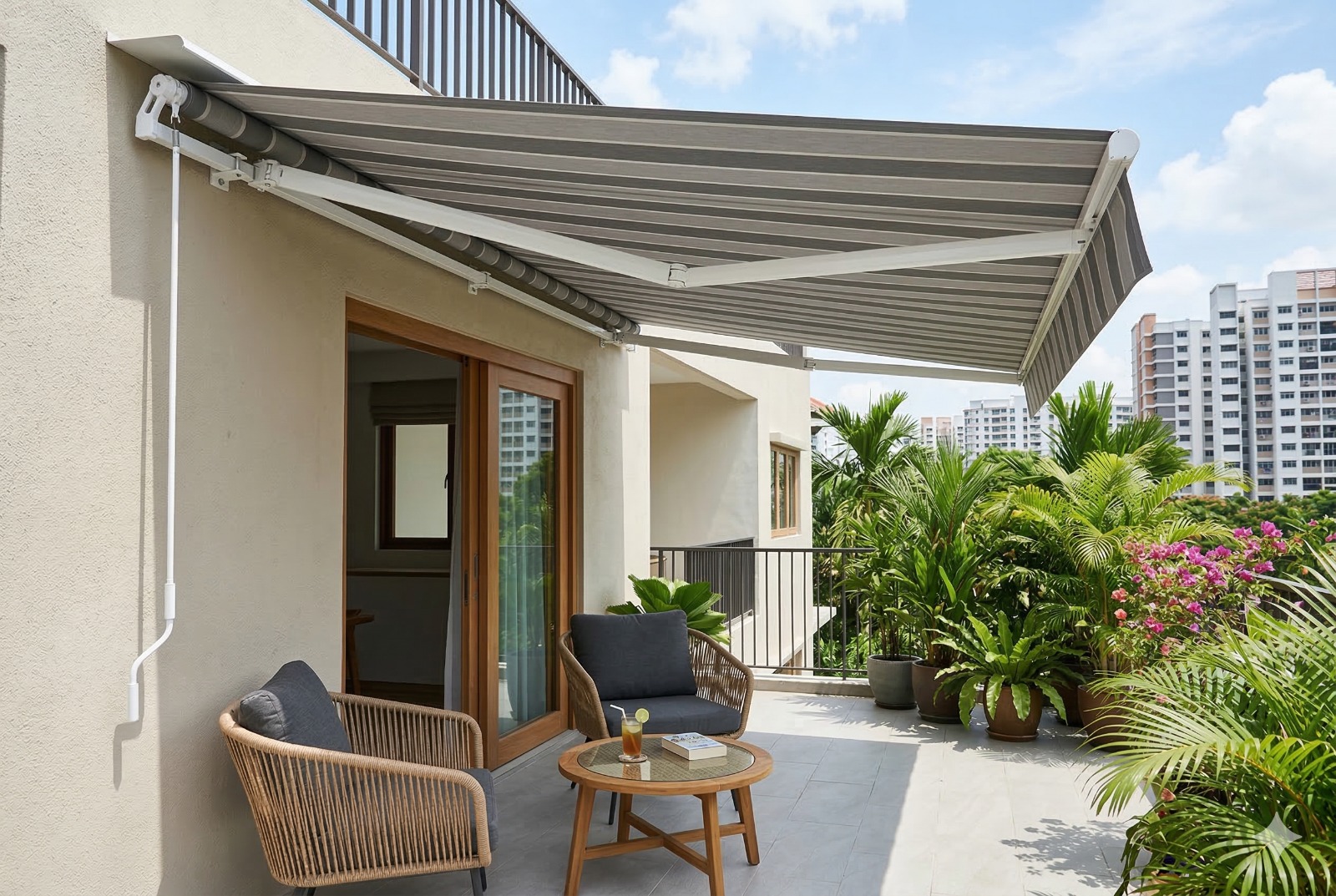
An awning is a secondary architectural covering attached to the exterior wall of a building, typically positioned over windows, doors, or outdoor spaces to provide protection from environmental elements. In the specific context of Singapore’s tropical climate, it functions as a critical barrier against intense UV radiation and heavy equatorial rainfall, constructed from durable materials like acrylic fabrics, polycarbonate, or glass supported by a rigid frame of aluminum or steel.
For homes and businesses, an awning serves to lower indoor temperatures by blocking direct solar heat gain, protects outdoor furniture from weathering, and extends the usable square footage of a property without the need for permanent, heavy-duty structural alterations.
Why We Actually Need Awnings in Singapore
Let’s be honest: Singapore’s weather is aggressive. One minute you’re squinting against a UV index that feels like it’s trying to cook you alive, and ten minutes later, you’re scrambling to shut your windows because a "Sumatra" squall just rolled in.
In our context, an awning isn't just a "nice-to-have" decorative piece. It’s a functional tool for survival in a tropical urban island. If you’ve ever lived in a unit facing the West Sun, you know that by 4:00 PM, your living room feels like a sauna. An awning intercepts that heat before it hits your glass windows. Once the heat passes through the glass, it’s trapped inside (the greenhouse effect). By stopping it outside, you can actually keep your home a few degrees cooler without having your air-con blast on "Powerful" mode all day.
The "Hardware" Problem: Surviving 100% Humidity
If you buy a cheap awning meant for a dry climate like Perth or Los Angeles, it will die in Singapore within eighteen months. Our humidity is a silent killer for outdoor structures. Here is the "human" breakdown of what actually lasts and what ends up in the bin.
1. The Fabric (Don't Get Cheap Here)
You’ll hear names like Sunbrella or Dickson thrown around. There’s a reason for that. Standard canvas or cheap polyester is just fabric with a layer of paint on top. Under our sun, that paint cracks and the fabric rots.
Solution-Dyed Acrylic: This is the gold standard. The color is part of the fiber itself. It doesn't fade into a weird, patchy grey after one year.
The "Mould" Factor: In Singapore, if it’s not breathable, it’ll grow green gunk. Good acrylic fabrics allow air to pass through, which keeps the area underneath from feeling "stuffy" and prevents moisture from being trapped in the rolls.
2. The Frame (The "Skeleton")
Steel is great until it’s not. In our salty, humid air, steel rusts. Even "stainless" steel can tea-stain and look ugly.
Powder-Coated Aluminum: This is what you want. It’s lightweight (easier on your walls), doesn't rust, and the powder coating acts like a tough skin that survives the rain-sun-rain cycle we deal with daily.
The Business Case: Turning "Dead Space" into Dollars
If you’re running a café in Katong or a bistro in Telok Ayer, you’re paying some of the highest rent in the world per square foot. Every square inch that you can’t use because it’s "too hot" or "too wet" is literally wasted money.
Doubling Your Seating
An awning allows you to reclaim the five or six feet in front of your shop. It creates an al fresco vibe that Singaporeans actually love—as long as they aren't being pelted by rain or scorched by the sun. It turns a "pass-through" sidewalk into a "stay-and-order-another-coffee" zone.
Branding Without the Permit Hassle
Putting up a massive neon sign in Singapore involves a mountain of paperwork. An awning, however, is a subtle way to splash your brand colors and logo across the street. It’s functional signage. It tells people, "Hey, we're here, and it's cool and dry under our roof."
The Homeowner’s Perk: Saving Your Stuff
We spend thousands on "designer" sofas, teak dining tables, and expensive curtains. Then we let the Singapore sun hit them for six hours a day.
The Fade: UV rays are basically bleach. They will destroy the color of your flooring and furniture. An awning is like putting SPF 50 on your house.
The "Rain-Proof" Balcony: For Condo dwellers, the balcony is often a "no-man's-land." You can't leave your cushions out because they’ll get soaked. A retractable awning gives you the choice. Extended when you want to read a book during a light drizzle; retracted when you want to look at the stars (if the clouds ever clear).
A Note on 2026 Tech: Smart Awnings
Since we’re living in 2026, we don't really do "manual cranks" anymore. Most modern setups in Singapore now come with wind sensors.
Why does this matter? Because we all forget. You’re at work in Raffles Place, and a massive storm hits your home in Jurong. A smart sensor detects the wind speed and automatically pulls the awning back in before the gusts can bend the arms. It saves you a $2,000 repair bill and a lot of heartbreak.
The Regulatory Side: Navigating the Red Tape
In Singapore, you can’t just bolt whatever you want to your exterior wall. Whether you’re a homeowner or a business owner, you have to play by the rules of the URA (Urban Redevelopment Authority), BCA (Building and Construction Authority), and, if you live in a condo, your MCST.
1. For Condo Owners
This is where it gets tricky. Your MCST (Management Corporation Strata Title) has the final say. Most condos have a "Standard Design" for awnings to ensure the building doesn't look like a patchwork quilt. If you install one that’s 2cm too long or the wrong shade of navy blue, they can—and will—make you take it down.
2. For Businesses
If your shop is in a conservation area (like Shophouses in Chinatown or Joo Chiat), the rules are even tighter. The URA wants to preserve the heritage look, so you’ll likely need a specific type of fabric awning rather than a modern polycarbonate one.
Maintenance: Keeping Your Investment from Rotting
Singapore’s humidity is essentially a slow-motion wrecking ball for outdoor structures. If you ignore your awning, it will become a breeding ground for algae and "bird bombs."
The Monthly Rinse: You don’t need fancy chemicals. Just a garden hose and a mild soap. Rinsing off the salt spray (especially if you live near the East Coast) and bird droppings prevents the fabric from eroding.
Dry Before You Retract: This is the #1 mistake people make. If it rains and you immediately roll up the wet awning, you are creating a dark, damp "mold sauna" inside the roll. Let it dry out in the sun before tucking it away.
WD-40 is Your Friend: For retractable versions, the mechanical joints need a little love once every six months. A quick spray keeps the movement smooth and prevents that "dying whale" screeching sound when you open it.
The ROI: Is It Actually Worth the Money?
Let’s talk numbers. A high-quality retractable awning in Singapore might set you back anywhere from $2,000 to $5,000+ depending on the size and tech.
Where do you get that money back?
Electricity Savings: If your awning shades a large glass sliding door, your air-con doesn't have to work nearly as hard. In a typical 4-bedroom condo, you could be looking at saving $30–$50 a month on power. Over five years, that’s $3,000 back in your pocket.
Asset Protection: Replacing a sun-damaged designer sofa or re-polishing bleached parquet flooring can cost way more than the awning itself.
Property Value: In the 2026 resale market, "usable outdoor space" is a massive selling point. A well-maintained awning makes your balcony feel like a premium feature rather than a hot, wasted slab of concrete.
2026 Trends: The "Smart" Awning
We’ve moved past the era of just "a piece of cloth on a stick." The latest trends in Singapore focus on Sustainability and Intelligence.
Solar-Powered Motors: Many new installations now feature a slim solar strip on top of the casing. This powers the motor, so you don't even need to hack your walls to run electrical wires. It’s 100% green and works perfectly in our sunny climate.
Integrated LED Lighting: Why stop using the space when the sun goes down? Modern awnings come with built-in, dimmable LED strips in the arms, turning your patio into a dinner-party-ready zone at the touch of an app.
Eco-Fabrics: We’re seeing a surge in fabrics made from recycled ocean plastics. They are just as durable as virgin acrylic but come with the peace of mind that you’re not adding more waste to the planet.
Final Verdict
An awning is essentially the "hat" for your building. You wouldn't walk around Sentosa at midday without protection, so why let your home or business do it?
In the Singapore context, it’s the most cost-effective way to fight the heat, manage the rain, and actually enjoy the outdoor space you’re paying so much rent for. Whether you go for a high-tech motorized version or a sturdy fixed canopy, the result is the same: a cooler, drier, and much more comfortable life.
