How Much Will a Retractable Awning in Singapore Cost for Your Property in 2026?
If you are thinking about installing a retractable awning in Singapore in 2026, the first question is usually the obvious one: how much is this going to cost me, really? And fair enough. Outdoor shading looks simple until the quotation lands and suddenly you are comparing fabric grades, motor systems, bracket types, and installation conditions like you are tendering for a mini construction project.
The short answer is that motorised retractable awning prices in Singapore commonly start from around S$2,000 for basic setups and can go beyond S$3,000 or more for larger, motorised, or more customised systems. Some suppliers also place acrylic fabric options and premium systems even higher depending on span, projection, and installation complexity.
That wide range is exactly why many property owners get stuck. A smaller manual awning for a modest balcony is a very different purchase from a motorised full-width patio awning for a landed home, café frontage, or commercial outdoor space. Same product family, very different bill.
In 2026, the better question is not just “What does a retractable awning cost?” but “What kind of retractable awning does my property actually need, and what am I paying for?”
What is the estimated cost of a retractable awning in Singapore in 2026?
As a general planning guide, you can expect these broad price bands in Singapore:
Mid-range motorised retractable awning: often starts higher, with motorisation alone potentially from S$2,000 onwards depending on your system.
Premium or highly customised installations: can go well above S$2,000 to S$20,000+ for larger spans, upgraded materials including led lights, or more demanding site conditions.
These are not fixed market rates. They are realistic guide prices based on current Singapore-facing supplier information and published local cost references. Final pricing can still vary depending on your property type, the dimensions required, and whether access or approvals make the job more complicated.
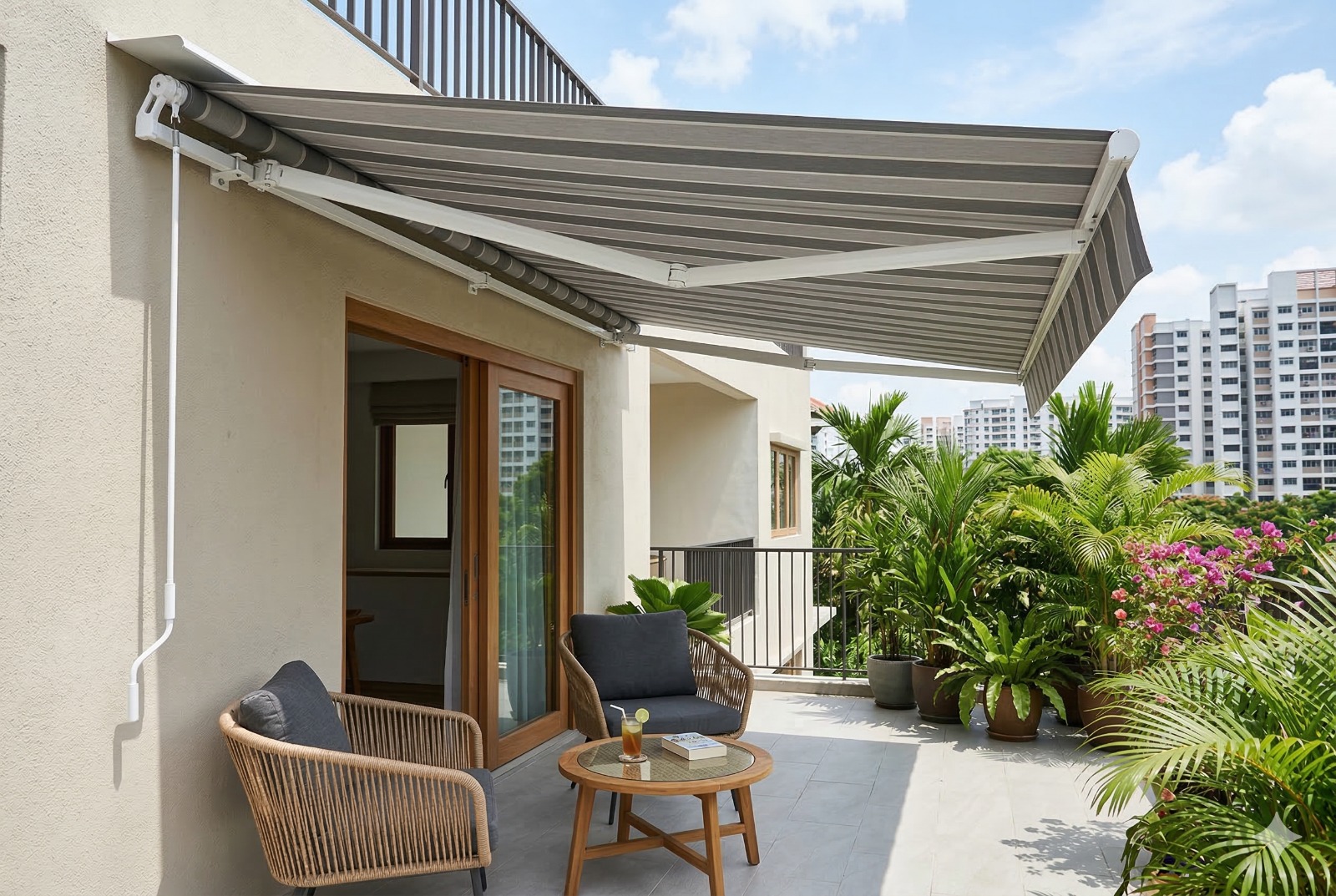
So yes, there is a big difference between “I want a simple sunshade above my balcony doors” and “I want a long-lasting motorised awning for a landed terrace that can handle regular use in our weather.” One is a straightforward home improvement. The other is a semi-technical outdoor system with moving parts, structural fixing requirements, and long-term maintenance considerations.
Why do retractable awning prices vary so much?
This is where many homeowners underestimate the quote. A retractable awning is not just fabric on arms. You are paying for a system, and the system has layers.
1. Size and projection
The most obvious cost driver is size. The wider the awning, and the further it projects outward, the more material, structural support, and engineering it needs. A short awning above a bedroom window is far cheaper than one meant to shade a patio dining area or shopfront seating zone.
In practical terms, a larger awning usually needs:
a heavier frame
stronger brackets and support arms
more durable retraction components
more labour for transport and installation
That is why price jumps can feel steep once you move from a compact residential width to something designed for a broader outdoor living area.
2. Manual vs motorised operation
Motorisation is another major factor. Some suppliers in Singapore explicitly note that motorised operation can add hundreds to over a thousand dollars to the cost.
For some owners, manual operation is perfectly fine. It is simpler and cheaper. But for others, especially if the awning is wide, high up, or used frequently, motorisation becomes less of a luxury and more of a practicality. Nobody wants a daily wrestling match with an outdoor shading system. Your awning should not become the most dramatic relationship in the house.
Motorised systems may also come with optional controls such as remote access or sensor compatibility, which can further increase cost.
3. Fabric and material quality
Not all fabrics are equal, and this matters more in Singapore than many realise. Heat, humidity, UV exposure, and sudden rain put outdoor materials under constant stress. Lower-cost fabrics may fade faster, sag earlier, or require replacement sooner.
Frame material also matters. Many retractable awning systems use aluminium components and corrosion-resistant fittings because outdoor durability is part of the value. Singapore suppliers commonly highlight aluminium alloy construction and stainless-steel parts for longer-term performance.
This means a cheaper upfront quote is not always the cheaper long-term decision. If the fabric ages badly or the moving parts wear out quickly, the “budget buy” can become a repeat expense.
4. Built-in features such as LED lighting
Another reason prices vary is the addition of built-in features. For example, some retractable awnings come with integrated LED lighting, which can make the sheltered area more functional and inviting after dark.
This is especially useful for homeowners who want to use their balcony, patio, or terrace in the evening, or for commercial spaces that want a more polished ambience. But naturally, added features mean added cost.
An awning with LED lighting may involve:
integrated light strips or built-in fixtures
extra wiring and electrical planning
added installation work
a more premium system overall
So if one quote includes lighting and another does not, the difference is not just about branding. You may be comparing a more basic shade solution against a more fully equipped system.
5. Installation difficulty
Installation is where the neat brochure meets the messy real world. Your quotation may go up if the installer has to deal with:
difficult wall conditions
unusual façade design
restricted access
height-related safety requirements
additional reinforcement or custom brackets
And then there is the compliance side. In Singapore, awnings may be subject to planning, façade, or technical agency requirements depending on the building type and context. URA states that retractable awnings in certain conservation contexts are subject to relevant technical agency requirements, and broader guidance on exterior features and façade maintenance also matters for strata developments.
That is why the cheapest quote is not always the safest or smartest one. If approvals, management rules, or installation standards are ignored, the savings can disappear very quickly.
One reason pricing feels vague is that suppliers are not quoting for “an awning”. They are quoting for your property condition, your usage pattern, and your installation constraints. That is why a condo owner, a landed homeowner, and a business operator can all ask for a retractable awning and receive very different numbers.
Condominiums and apartments
For condo owners, the biggest wildcard is usually management approval. Even if the awning itself is technically feasible, MCST rules may restrict what can be installed on the exterior, balcony edge, or façade-facing areas. Uniformity, visibility from outside, and water discharge issues can all come into play.
Cost-wise, condo awnings often move into the mid-range quickly because balcony spans are not always tiny, and access for installation may be more complicated than expected. Height, drilling conditions, and coordination with building rules can all add friction to what seems like a simple job.
In plain English: the awning may fit your balcony, but the paperwork may decide whether it fits your building.
Landed properties
Landed homes usually have the most flexibility and also the biggest variation in pricing. A compact retractable awning above a side window may be relatively manageable. A wide motorised system for a patio, car porch edge, or outdoor seating zone is a different story.
For landed properties, total cost often rises because owners typically want one or more of the following:
wider coverage
longer projection
motorised use
better fabric performance
a cleaner architectural finish
This is where quotations can climb past the entry-level range fast. The system is larger, the exposure to sun and rain is heavier, and the expectation is usually for frequent long-term use rather than occasional shading.
Commercial properties
For cafés, restaurants, retail frontages, and other business settings, retractable awnings can become both a functional and branding investment. A business may need larger spans, stronger visual finishes, better fabric appearance, or higher-duty usage capability. If the awning is opened and closed regularly, that usage cycle matters.
Commercial buyers should also expect more attention to:
branding or printed fabric
weather resistance
user convenience
frontage presentation
ongoing servicing
That means the true cost is not only the installed system. It may also include the cost of downtime, repair response, and whether the awning continues to look presentable after prolonged exposure. A tired-looking awning on a shopfront does not exactly whisper “premium business”. It usually shouts the opposite.
Hidden costs to watch out for
This is where budget planning gets real. The headline quote may not be the full story.
Electrical works for motorised systems
If you choose a motorised retractable awning, electrical point provision may or may not be included. Some suppliers handle only the awning system itself, while electrical routing, switch installation, or power-point relocation may be separate.
Reinforcement or custom brackets
Certain walls or structural conditions may require additional supports or custom fabrication. That can push the final amount up, especially if your wall condition is less straightforward than expected.
Delivery and access constraints
Difficult site access, upper-floor installations, or tighter installation environments may result in added labour charges. If scaffolding, lift access coordination, or additional safety measures are required, costs can increase.
Maintenance and replacement
Retractable awnings have moving parts. Over time, components such as motors, arms, joints, or fabric may need servicing or replacement. A lower entry price can look attractive until maintenance becomes frequent or spare part support becomes unclear.
This is why buyers should ask not only:
What is the installation price?
but also:What does the warranty cover?
How long is the fabric expected to last?
Are spare parts available locally?
Who handles servicing if something goes wrong?
Are retractable awnings worth the cost in 2026?
For the right property, yes. But not by default.
A retractable awning can make sense when you want flexible shading without committing to a fixed permanent covering. It can reduce heat and glare, improve outdoor usability, and create a more comfortable transition space for balconies, patios, or storefronts. The retractable function is especially useful in Singapore, where conditions can flip from punishing sun to sudden rain with very little warning.
That said, value depends on whether the system fits your actual use case. If you only need constant weather protection and never plan to retract it, a different shading solution may offer better value. If you want convenience, appearance, and adaptable shelter, a retractable awning can justify the higher spend.
Final thoughts
In 2026, most property owners in Singapore should expect a retractable awning to cost anywhere from around S$2000 to S$20,000 or more, depending on size, operation type, material quality, and installation conditions. Manual systems sit at the more affordable end, while larger motorised and customised systems naturally cost more.
