How Much Does Fixed Awning Cost in Singapore?
Installing a fixed awning in Singapore is less of a "luxury upgrade" and more of a "survival strategy" against the relentless tropical sun and sudden monsoon downpours. Whether you are looking to shield your balcony from the afternoon glare or keep your patio dry for a weekend BBQ, understanding the cost structure is vital before you commit to a contractor.
In this first half of our comprehensive guide, we will break down the primary cost drivers, material choices, and initial price estimates for fixed awning installations in 2026.
The "Invisible Umbrella": Why Fixed Awnings are a Singapore Staple
In Singapore, the weather generally oscillates between "intensely hot" and "extremely wet." A fixed awning acts as a permanent architectural extension of your home, providing 24/7 protection that retractable versions often can’t match in terms of structural durability.
While retractable awnings offer flexibility, fixed awnings are the preferred choice for those who want a "set it and forget it" solution. They are sturdier, require significantly less mechanical maintenance (no motors to burn out or cranks to jam), and can be engineered to handle the high wind speeds often encountered in high-rise balconies or coastal landed properties.
The Value Proposition
Beyond just shade, a well-installed fixed awning:
Reduces Cooling Costs: By blocking direct sunlight before it hits your glass windows, you can lower indoor temperatures by up to 5°C - 8°C, significantly reducing the load on your air-conditioning.
Expands Living Space: It effectively turns a "dead" balcony or patio into a functional "outdoor room."
Protects Furniture: UV rays are notorious for bleaching expensive outdoor teak sets and indoor curtains.
1. The Cost Matrix: What Are You Actually Paying For?
When you receive a quote for a fixed awning in Singapore, the final figure isn't just a random number. It is a calculated sum of four distinct components. Typically, for a standard residential project, the price ranges from $2,000 to $4,500, but this fluctuates based on the following:
A. Material Selection (The Roof)
This is the most significant variable. In 2026, the market is dominated by three main materials: Polycarbonate, Aluminium Composite Panels (ACP), and Tempered Glass.
B. Structural Framework (The Skeleton)
Most awnings in Singapore use hollow-section aluminium or galvanized steel. Aluminium is the gold standard here because it is naturally rust-resistant—a non-negotiable trait given Singapore’s high humidity and salt air (especially if you live in areas like Pasir Ris or East Coast).
C. Installation Complexity (The Labour)
Installing an awning on a ground-floor patio is a straightforward job. Installing one on the 30th floor of a condo balcony requires specialized safety equipment, scaffolding, or even rope-access technicians (spidermen). High-rise installations can add a $500 to $1,200 premium just for safety and logistics.
D. Regulatory Compliance (The Paperwork)
In 2026, HDB and BCA (Building and Construction Authority) regulations have become more streamlined but remain strict. Depending on your property type, you may need a Professional Engineer (PE) to endorse the design, which carries a flat fee.
2. Material Deep Dive & Price Per Square Foot (PSF)
In Singapore, contractors usually quote based on a per square foot (PSF) basis or a lump sum for standard sizes. Here is how the materials stack up in the current market:
Polycarbonate Awnings: The Popular Choice
Polycarbonate is the "all-rounder." It’s lightweight, virtually unbreakable, and allows natural light to filter through while blocking UV rays.
Estimated Cost: $18 to $30 per sq. ft.
Pros: Flexible designs (can be curved), various tints (clear, bronze, grey), and very cost-effective.
Cons: Can be noisy during heavy rain (the "drumming" effect) and can become brittle after 10–12 years of intense UV exposure.
Aluminium Composite Panels (ACP): The Heavy-Duty Shield
ACP consists of two thin aluminium sheets bonded to a non-aluminium core. It is completely opaque, meaning it provides 100% shade.
Estimated Cost: $25 to $45 per sq. ft.
Pros: Excellent heat insulation, modern "flat" aesthetic, and very quiet during rain. It is often fire-rated, making it a favorite for commercial and HDB shopfronts.
Cons: No natural light passes through, which might make your interior feel darker.
Glass Awnings: The Premium Aesthetic
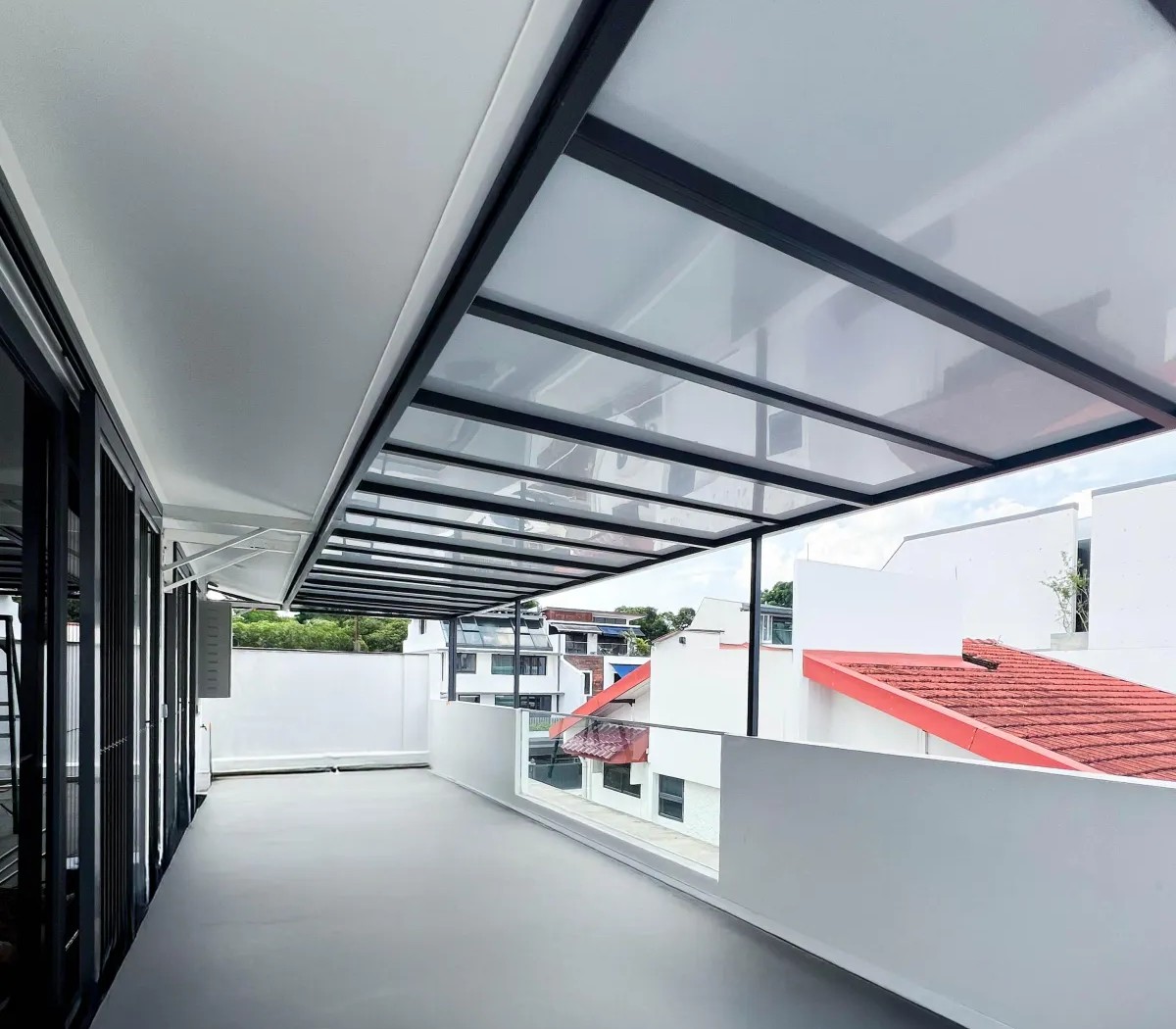
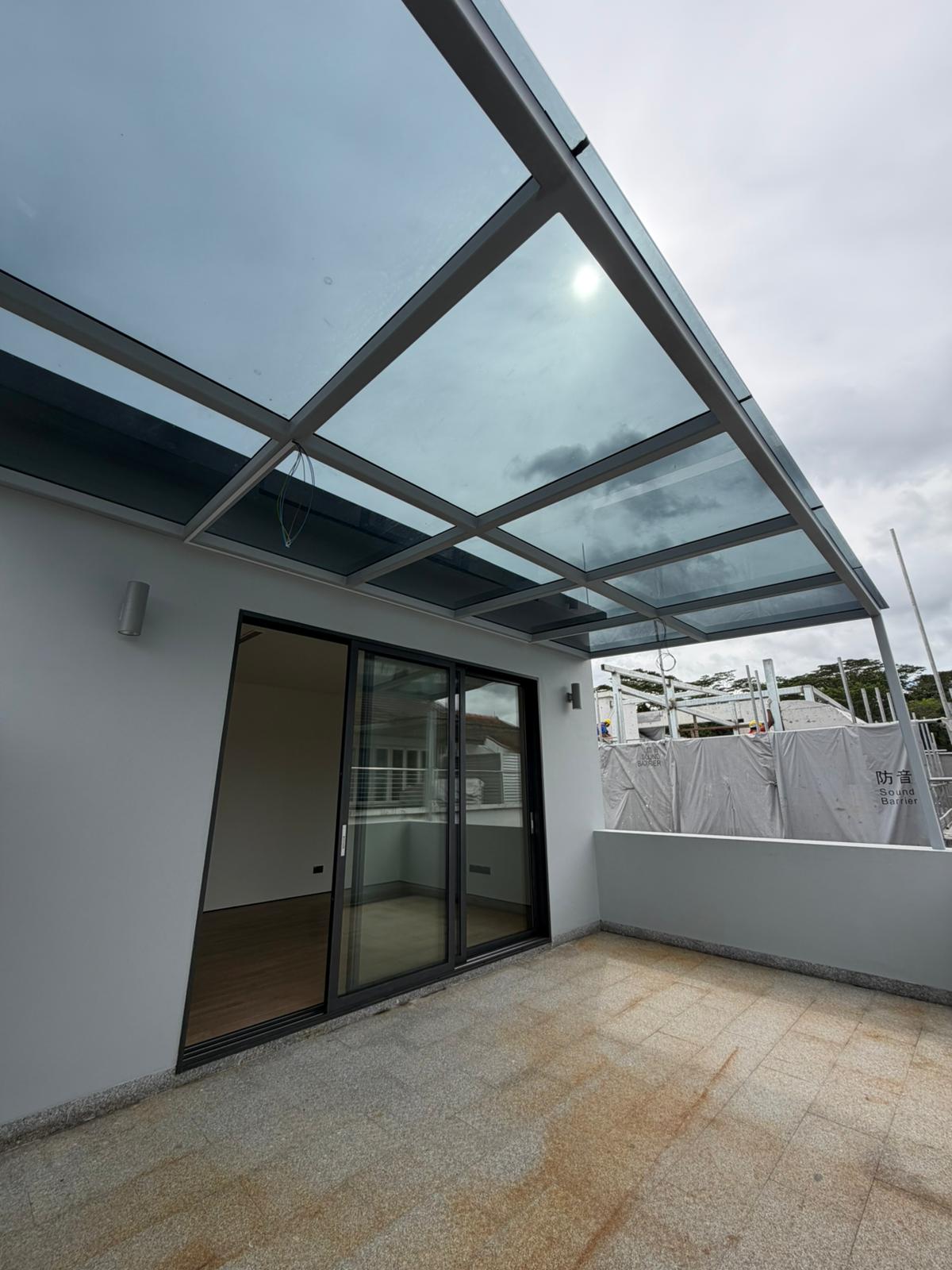
For a sleek, high-end look, tempered and laminated glass is the go-to. It is usually supported by a heavy-duty steel or aluminium frame.
Estimated Cost: $60 to $120+ per sq. ft.
Pros: Highly durable, easy to clean, and provides a "seamless" look that doesn't obstruct views.
Cons: Extremely heavy (requires significant structural reinforcement) and the most expensive option.
3. Average Price Ranges by Project Type
To give you a clearer picture, here are the "all-in" price estimates you might see in a 2026 quotation for common Singaporean residential setups:
4. The "Hidden" Costs of Installation
When budgeting, many homeowners forget to account for the logistical realities of Singaporean construction.
Scaffolding & Access: If your installation point cannot be reached by a standard ladder, your contractor will charge for scaffolding. For high-rise units, a "Boom Lift" or "Scissor Lift" rental can cost $300 - $600 per day.
Waterproofing & Sealing: A fixed awning is only as good as its seal against the wall. Ensure your quote includes high-grade silicone sealant and "flashing" (a metal strip that prevents water from seeping between the wall and the awning). If this is treated as an "add-on," it might cost an extra $150 - $300.
Disposal of Old Structures: If you are replacing an old, rusted awning, the dismantling and disposal fee usually sits around $100 - $250.
5. Navigating the Red Tape: BCA, HDB, and URA Regulations (2026)
In Singapore, you can’t simply bolt a giant sheet of metal to your wall and call it a day. As of 2026, the Building and Construction Authority (BCA) and the Housing & Development Board (HDB) have tightened safety standards to ensure that awnings don’t become "flying hazards" during our increasingly frequent heavy storms.
HDB & Condo Regulations
Top-Floor Units: If you live on the topmost floor with an "open-to-sky" balcony, you must obtain HDB/MCST approval. This is because your awning changes the building’s silhouette and affects drainage for the entire block.
The 1.4m Rule: Generally, awnings that protrude more than 1.4 metres from the wall require a Professional Engineer (PE) to certify the structural load.
Uniformity By-Laws: Most Condominiums (MCSTs) have a "Design Guideline." You cannot install a bright orange awning if the building's approved colour is charcoal grey. Installing an unauthorized design can result in a legal notice to "reinstate" (tear it down) within 14 days.
BCA "Exempted" Works
The good news? Under the latest 2026 amendments, most small residential shelters (under 10 square metres) that are not used as safety barriers are considered "insignificant building works" and don’t require a full BCA permit. However, if your landed property patio awning exceeds 50 square metres, you’re entering "structural addition" territory, which requires formal plan submission.
6. The Contractor Selection Playbook
With over 200 awning installers in Singapore, the price gap can be massive. A "cheap" quote often hides poor workmanship that leads to ceiling leaks six months later. Here is how to vet your contractor:
The "Must-Have" Checklist
ACRA & BizFile: Ensure they are a registered business. In 2026, many "freelance" installers operate via social media without insurance.
Public Liability Insurance: Ask specifically: "Are you covered if the awning falls and hits a neighbour’s car during installation?" If the answer is "No," walk away.
Portfolio Match: Don’t hire a contractor who only does HDB window hoods to do a complex 3-storey landed glass roof. The structural requirements are completely different.
Pro Tip: Ask for a detailed, itemized quotation. A quote that simply says "1x Awning - $3,500" is a red flag. It should break down the frame material, roof thickness (e.g., 3mm Polycarbonate vs 6mm), and the specific type of sealant used.
7. The Maintenance Cheat Sheet: Extending the Life of Your Awning
Singapore’s high UV index and humidity are the natural enemies of fixed awnings. Without maintenance, even a premium glass awning will look like an abandoned greenhouse within two years.
Quarterly Tasks (Every 3 Months)
Clear the Gutters: Dead leaves from nearby rain trees are the #1 cause of "awning overflow." When gutters clog, water seeps backward into your wall, causing internal dampness.
Soft Wash: Use a mild, pH-neutral soap (like dish soap) and a soft brush. Never use a high-pressure jet on polycarbonate; it can micro-crack the UV coating, causing it to yellow faster.
Inspect the Sealant: Check the "flashing" (the line where the awning meets the wall). If the silicone is peeling, water will drip down your windows during the next monsoon.
Annual Structural Audit
Check the bolts and brackets for Tea Staining (initial rust). Even "stainless steel" can rust in Singapore’s salty air. If you see brown spots, sand them down and apply a rust-inhibiting primer immediately.
8. Summary: The Total Cost of Ownership
To wrap up, a fixed awning is an investment that pays for itself in reduced electricity bills and increased property value. Here is the final breakdown of what a "realistic" budget looks like in 2026:
Final Verdict: Is it Worth It?
If you have a balcony that is currently a "no-go zone" between 1 PM and 5 PM, the answer is a resounding yes. While a $3,000 price tag might seem steep, spreading that cost over a 15-year lifespan comes out to roughly $0.50 a day for a cooler, dryer, and more functional home.
In a land-scarce city like Singapore, expanding your usable square footage vertically is the smartest renovation move you can make. Just remember: Prioritize the frame quality and the waterproofing over the aesthetic tints. A beautiful awning that leaks is just a very expensive sieve.
