
Does a Pergola on a Condo Require MCST Approval? What's the Process?
Does a Pergola on a Condo Require MCST Approval? What's the Process?
If you own a condominium unit in Singapore and you're thinking about installing a pergola on your balcony, roof terrace, or private enclosed space, the short answer is yes — you almost certainly need approval. But from whom, and how complicated is the process? The answer involves more than one authority, and getting it wrong can cost you significantly more than the pergola itself.
Here's everything you need to know before a single post goes into the ground.
Why Approval Is Required in the First Place
In Singapore, condominiums are strata-titled developments governed by the Building Maintenance and Strata Management Act (BMSMA). Under this legislation, your Management Corporation Strata Title — the MCST — has statutory powers to approve or reject any renovation or installation that may affect common property, the building's structural integrity, or the external facade of the development.
A pergola, even one installed on what feels like your private balcony, almost always falls into at least one of these categories. Balconies in condominiums sit on the exterior of the building and contribute to the overall facade. Any permanent structure attached to them — a frame bolted to the floor slab, posts anchored into the balcony deck, or a roof system that adds visual mass to the exterior — touches on what the MCST is legally empowered to regulate.
Skipping this step carries real consequences: fines under the BMSMA, forfeiture of your renovation deposit, stop-work orders, and in persistent cases, a forced reinstatement at your expense.
MCST Approval: The First and Non-Negotiable Step
Before you approach any other authority, you need sign-off from your MCST. This is the gatekeeper, and no contractor worth engaging will begin work without it.
Each condominium development has its own Deed of Mutual Covenant (DMC) and set of by-laws, so the specific restrictions vary from project to project. Some MCSTs are relatively permissive about balcony additions; others have strict rules about maintaining a uniform facade across all units. You need to read your condo's by-laws carefully before assuming anything is allowed.
In general terms, your MCST will evaluate whether the proposed pergola affects the building's external appearance, places additional load on a structural element, intrudes on common property, or creates a nuisance or safety hazard for neighbours. A freestanding pergola sitting on a large private enclosed space may face fewer objections than one anchored to balcony walls and visibly altering the facade of a high-rise tower.
To submit for MCST approval, you will typically need to prepare the following:
A completed renovation application form (available from your managing agent)
Detailed drawings or floor plans showing the proposed pergola, its dimensions, and how it will be anchored
Your appointed contractor's credentials — most MCSTs only accept BCA-licensed or BizSafe-certified contractors
An indemnity letter acknowledging liability for any damage to common property during installation
A refundable security deposit, typically ranging from S$500 to S$5,000 depending on the development
Submit these documents to your managing agent. The MCST review process typically takes between five and ten working days, though more complex or unusual installations may trigger a request for revisions or an in-person committee presentation. Factor in a total timeline of two to three weeks before you receive written approval.
Once approved, you will be issued a formal renovation permit specifying the approved scope, permitted working hours, and contractor access conditions. Keep this document; it is your proof of compliance.
When BCA Also Gets Involved
Beyond the MCST, certain pergola installations will trigger scrutiny from the Building and Construction Authority (BCA). This happens when the structure involves load-bearing elements, anchors into the building slab or structural walls, or adds significant weight to the balcony.
BCA's concern is structural safety. A pergola that is simply resting on a balcony floor with minimal anchoring is treated differently from one that is bolted through the slab or attached to the building facade in a way that affects the structural frame.
If your pergola installation qualifies as Addition and Alteration (A&A) works — meaning it constitutes a structural change to the building rather than a cosmetic addition — you will need to engage a Qualified Person (QP), typically a registered architect or professional engineer, to assess and certify the design. This person will submit the building plans to BCA for approval before any work can commence. Do not engage a contractor for structural A&A works without a licensed builder; homeowners cannot apply for BCA building plan approval directly.
As a practical rule: if the pergola is freestanding, lightweight, and anchored only with surface-level fixings, BCA involvement may not be required. If it involves drilling through the slab, fixing to the facade, or supporting a heavy louvred roof system, assume you will need a QP and factor that cost into your budget — professional engineer fees in Singapore typically range from S$800 to S$2,000 for residential assessments.
The URA Question
The Urban Redevelopment Authority governs Singapore's land use planning and the external appearance of buildings. For most standard balcony pergolas on condominiums, URA's written permission is not required — but there are conditions where it becomes relevant.
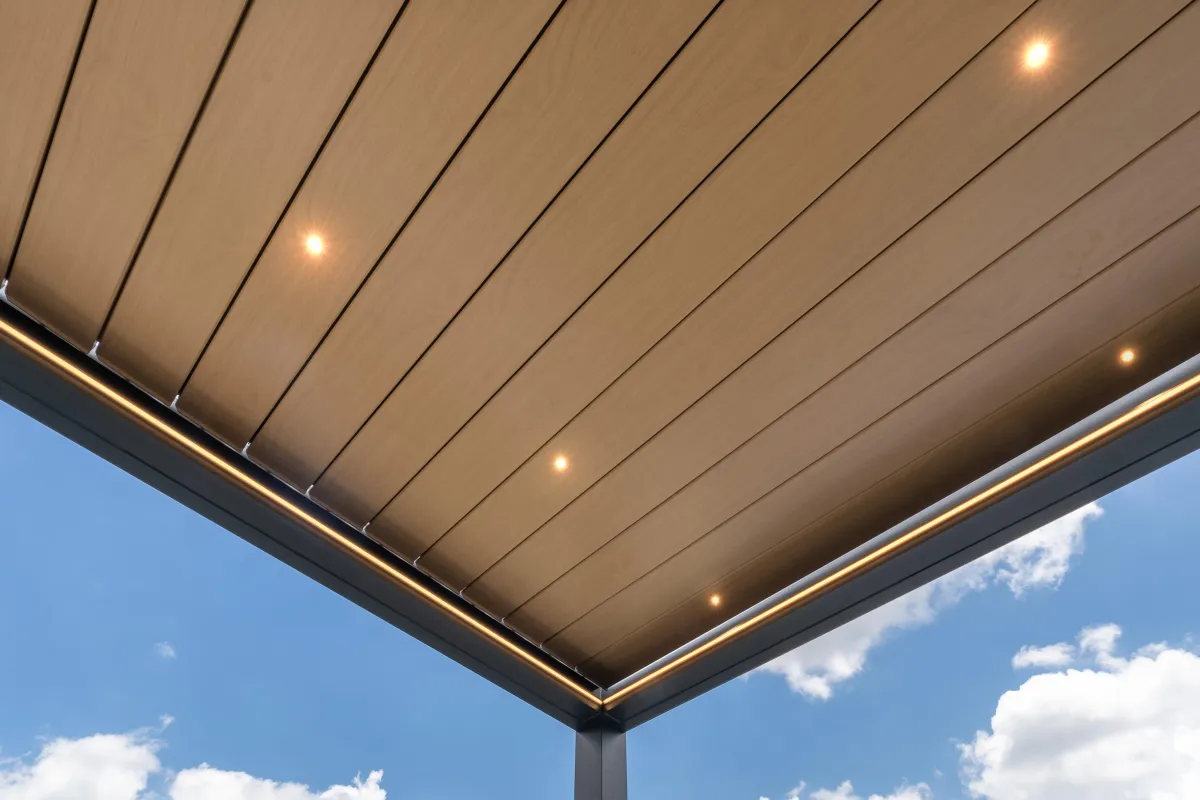
URA guidelines specify that retractable screens or structures that allow the balcony to remain naturally ventilated at all times do not require URA approval, provided the balcony was originally approved as a covered balcony and complies with building setback requirements. This is an important carve-out: if your proposed pergola has a retractable roof system — like motorised louvres that open fully — you may avoid the URA step entirely.
However, if the pergola creates a permanent enclosure or a fixed roof that materially changes the balcony's status from an open semi-outdoor space to an enclosed area, URA may need to be consulted. Any external change that affects the gross floor area calculation, alters the building height profile, or modifies the approved facade will likely trigger a URA review. When in doubt, your appointed QP or a reputable contractor familiar with Singapore's regulatory landscape should be able to advise you.
What Happens If You Skip the Process
It is tempting to assume that a small structure on a private balcony won't attract attention. In practice, Singapore's condominium management teams conduct regular inspections, and neighbours often report unapproved works — particularly when they affect the view or facade uniformity of a building.
The consequences of proceeding without approval are materially worse than the inconvenience of getting it right. Your MCST can issue a stop-work order immediately. BCA can compel reinstatement of the original condition, with costs borne entirely by you. Fines under the BMSMA range from S$100 to S$1,000 per incident, and serious violations can be referred to BCA for further enforcement. If the unapproved structure is discovered during a property sale, it can complicate or delay the transaction.
Getting the approvals in order also protects you from future liability: if an improperly installed pergola causes water ingress into the unit below or damage to common property, the indemnity letter you signed during the MCST application process becomes legally significant.
The Practical Timeline
If you are planning a pergola installation on your condo balcony, here is a realistic sequence:
Review your condo's by-laws and DMC first, before spending any money on design or contractor quotations. Confirm what your MCST permits in terms of balcony structures and external facade alterations.
Engage a reputable contractor or design firm familiar with MCST submissions. Ask explicitly whether they handle the approval paperwork on your behalf — most experienced ones do.
Submit the MCST application and wait for written approval before proceeding. Two to three weeks is a standard timeline.
If your contractor identifies structural anchoring requirements that qualify as A&A works, engage a QP for the BCA submission in parallel. This adds time and cost but is non-negotiable for structural modifications.
Only once all written approvals are in hand should installation begin. Keep copies of every approval document and make sure your contractor has access to them on-site.
The Bottom Line
A pergola on a condo balcony in Singapore is not a simple weekend project. It sits at the intersection of MCST by-laws, BCA building control, and in some cases URA guidelines — all of which carry enforcement teeth. The process is manageable and many pergola installations are approved without drama, but only when approached in the right order and with the right documentation. Start with your MCST, understand whether your design triggers BCA involvement, and get everything in writing before a single post touches your balcony floor.
Looking for a pergola roof contactor?. We've installed pergolas across condominiums, landed homes, and penthouses throughout Singapore — from sleek motorised louvred roofs that satisfy MCST facade requirements, to lightweight aluminium structures designed for compact balconies. We know what works in Singapore's climate, and we know what gets approved. Contact us to book a free on-site consultation.
