Do I need a Professional Engineer (PE) endorsement for my pergola on my landed property?
Building a pergola on your landed property in Singapore often feels like navigating a maze of acronyms—URA, BCA, PE, QP. In 2026, the regulations have become even more nuanced as Singapore pushes for "Green Plot Ratio" and more sustainable outdoor living.
The short answer is: It depends on the size, weight, and how it’s attached. While some small trellises are "set-and-forget," once you cross a certain threshold of complexity, a Professional Engineer (PE) becomes mandatory for both safety and legal compliance.
1. The "Insignificant Building Works" Exemption
The Building and Construction Authority (BCA) provides a list of works that do not require formal plan submission or a permit. These are categorized as "Insignificant Building Works." If your pergola fits perfectly within these boundaries, you likely won't need a PE to sign off on the structural plans.
The 10 Square Metre Rule
Under current 2026 guidelines, a single-storey, open-sided shelter (like a gazebo or pergola) is exempt if it does not exceed 10 square metres in area.
Ground Installation: If you are building a small BBQ corner or a modest shaded area for your home gym equipment in the garden, and it stays under this 10sqm limit, you are generally in the clear.
Roof Installation: This rule also applies if you are putting the structure on your roof terrace. However, the structural integrity of the existing roof must be able to support the added load, which is where things get tricky.
The Horizontal Projection Rule
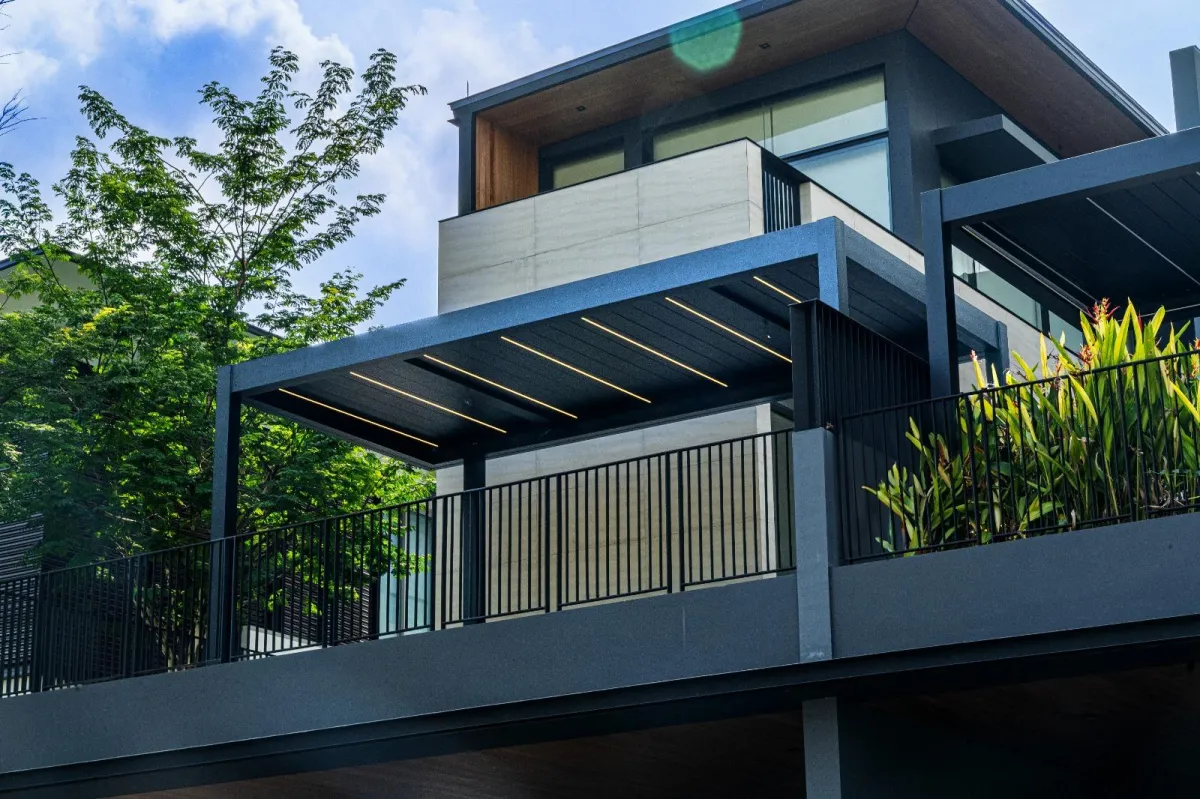
If your pergola is a cantilevered structure (attached to the side of your house rather than standing on four pillars), the limits change based on material:
Lightweight Materials/Glass: If the roof is made of lightweight polycarbonate, fabric, or glass (not exceeding 13mm thick), the horizontal projection can be up to 3,000 mm (3 metres) without needing BCA approval.
Tiles (Clay/Glazed): If you are using heavier materials like traditional roof tiles, that projection limit drops significantly to 1,400 mm.
2. Why the "Open-Sided" Definition Matters
In the eyes of the URA and BCA, a pergola is only a pergola if it is "open-sided." This isn't just a design choice; it’s a legal definition that affects your Gross Floor Area (GFA).
If you start adding permanent walls, glass enclosures, or heavy Ziptrack screens that remain closed 90% of the time, the authorities may reclassify your pergola as an extension of your house.
Consequence: Once it’s an extension, it counts towards your plot ratio. If your landed property is already at its maximum GFA, you could be ordered to demolish the structure.
The PE Role: If the structure is semi-enclosed, a PE is almost always required to calculate wind loads, as a "closed" box catches wind differently than an "open" structure, creating a potential "sail effect" during a Sumatra Squall.
3. The "Qualified Person" (QP) vs. The "Professional Engineer" (PE)
Many homeowners use these terms interchangeably, but they serve different functions in the 2026 regulatory landscape.
The Architect (QP): Usually focuses on the aesthetic and URA submission (ensuring the pergola doesn't violate setback rules or site coverage).
The Professional Engineer (PE): Focuses on the "math." They ensure that if a 100km/h wind hits your aluminum louvers, the pillars won't buckle or fly into your neighbor’s yard.
When a PE is Non-Negotiable
Even if your pergola is small, you will need a PE endorsement if:
It’s Fixed to the Main Structure: If you are bolting the pergola into your existing house beams, a PE must verify that the house can take the extra torque and weight.
It Requires Piling: If your soil is soft (common in areas like Paya Lebar or Katong) and your pergola is heavy enough to require concrete footings or micro-piles, a structural engineer must design those foundations.
It Features Glass: Large glass-roofed pergolas have strict safety requirements. A PE must certify that the glass is tempered/laminated and that the frame can support its significant dead weight.
4. URA Setbacks: The Invisible Boundaries
While BCA cares if the structure falls down, the Urban Redevelopment Authority (URA) cares where it sits. Landed properties have strict setback requirements (usually 2 metres from the side and rear boundaries).
Permanent Structures: Generally, no permanent building structure can encroach into the setback zone.
The Pergola Exception: Lightweight, open-sided pergolas are sometimes allowed within the setback, provided they are not considered "habitable space" and meet specific height limits (usually not exceeding the height of the first storey).
If you are planning to build right up to your boundary wall to maximize your outdoor DJ booth or entertainment area, you must check the 2026 URA Master Plan for your specific zone. Building within the setback without a proper QP/PE consultation is the #1 reason for "Notice of Deviations" in Singapore.
5. The Financial Reality: PE Endorsement Costs in 2026
If you determine that your project falls outside the "insignificant" category, you need to budget for professional fees. In 2026, the cost of a Professional Engineer (PE) endorsement for a residential pergola typically ranges from $1,500 to $4,500, depending on several factors:
Complexity of Design: A standard four-pillar aluminum pergola is straightforward. However, if you are designing a cantilevered structure that "hovers" over a pool or uses heavy glass roofing, the engineering calculations become more intensive, pushing fees toward the higher end.
Site Visits and Inspections: A PE doesn't just sign a piece of paper. They are legally responsible for the structure's safety. This usually involves at least two site visits—one for the initial assessment and one for the final inspection after installation.
Soil Testing: For massive, heavy-duty pergolas in landed estates with soft soil (common in Singapore’s "East Coast" reclaimed or marshy areas), a PE may require a soil report to design the proper footings, which can add another $1,000 to $2,000 to your pre-construction costs.
6. SCDF Fire Safety: The 2026 Compliance Shift
Fire safety is often the most overlooked part of pergola planning. Under the 2026 Fire Code updates, the Singapore Civil Defence Force (SCDF) has tightened regulations regarding "ancillary structures."
The 1-Metre Boundary Rule
If your pergola is located within 1 metre of your property boundary wall, it must be constructed using non-combustible materials.
Aluminum vs. Timber: While timber is beautiful, it is highly combustible. If your pergola is near your neighbor's fence, SCDF guidelines in 2026 essentially smandate the use of powder-coated aluminum or fire-rated steel.
Roofing Materials: If you are using fabric or polycarbonate, ensure it carries a Class 0 or Class 1 flame spread rating. Using non-certified materials can lead to your insurance being voided in the event of a fire.
Proximity to Openings
Your pergola cannot be placed in a way that allows fire to "bridge" from the outdoor area into the main house. If your pergola roof is adjacent to a bedroom window or a balcony door, there are specific clearance requirements to ensure a fire on the patio doesn't immediately engulf the interior.
7. The "Deemed to Comply" Checklist for Homeowners
To help you decide if you need to call in the professionals, use this 2026 "Deemed to Comply" checklist. If you can check "Yes" to all of these, you likely do not need a formal PE submission:
[ ] Total Area: Is the structure 10 square metres or less?
[ ] Open Sides: Are at least two sides completely open (no permanent walls or heavy screens)?
[ ] Height: Is the structure a single storey and below 4 metres in total height?
[ ] Location: Is it positioned at least 2 metres away from the side and rear boundaries (setback zone)?
[ ] Roof Weight: Is the roofing material lightweight (e.g., aluminum louvers or thin polycarbonate) rather than heavy clay tiles?
[ ] Standalone: Is it a freestanding structure that doesn't rely on the main house for structural support?
Note: If your answer to any of these is "No," you should consult a Qualified Person (QP) before proceeding with construction to avoid potential fines or "stop-work" orders from BCA.
8. Why Professional Consultation Saves Money Long-Term
It is tempting to skip the PE to save a few thousand dollars, but in the 2026 Singapore property market, the risks far outweigh the savings.
Unauthorized Building Works (UBW): If you ever decide to sell your landed home, the buyer’s lawyer will conduct a legal search. If your pergola isn't in the approved plans, you will be forced to undergo a "regularization" process—which costs double the original fee—or demolish it entirely before the sale can go through.
Insurance Liability: If a windstorm damages your pergola and it hits your neighbor’s car, your insurance company will check if the structure was legally built. No PE endorsement (when required) equals no payout.
Structural Peace of Mind: We aren't just talking about rain; we are talking about safety. A PE ensures your outdoor sanctuary is a safe place for your family to gather, regardless of what the Singapore weather throws at it.
Conclusion
Building a pergola on your landed property is one of the best ways to enhance your lifestyle and property value in 2026. However, the line between an "insignificant work" and a regulated structure is thin. By understanding the 10sqm rule, SCDF material requirements, and the role of a Professional Engineer, you can build with confidence rather than worry.
Don’t let the complexity of building codes stop you from creating your dream outdoor space. The specialists at roof.com.sg are ready to help you navigate the 2026 regulations and find the perfect smart pergola for your specific space. Contact us at today to schedule your free on-site consultation and take the first step toward your dream outdoor sanctuary.
