Aluminium Composite Roof vs. Polycarbonate Roofs
When deciding between Aluminium Composite Panels (ACP) and Polycarbonate for a roof terrace or awning, the choice is a direct trade-off between thermal comfort and natural light.
If your priority is a cool, low-maintenance outdoor living space that feels like an extension of your home's interior, ACP is the superior choice. If you prioritize a bright, airy aesthetic and want to maintain a "sky-view" or greenhouse feel, Polycarbonate is the better option.
1. Thermal Comfort: The Tropical Heat Factor
In Singapore’s relentless humidity and 32 degrees, heat management is the single most important factor for any roof terrace.
Aluminium Composite Panels (ACP)
ACP acts as a total sunblock. It consists of two thin aluminium sheets bonded to a central core (typically polyethylene or a fire-retardant mineral). This "sandwich" structure, combined with its opaque nature, provides exceptional thermal insulation.
Heat Reduction: Blocks $100% of direct UV rays and radiant heat.
Ambient Temperature: The area underneath an ACP roof can feel up to 5 Degrees cooler than the surrounding air.
Glare: Zero glare. It creates a "ceiling" effect, making it comfortable to use laptops or screens outdoors.
Polycarbonate Sheets
Polycarbonate is a translucent thermoplastic. While it reflects some UV rays, it allows visible light (and the heat that comes with it) to pass through.
Greenhouse Effect: Even with UV-resistant coatings, heat builds up under the panels. Without adequate side ventilation, a polycarbonate-enclosed terrace can become a "toaster."
Heat Transmission: Darker tints (bronze/grey) reduce heat more than clear sheets, but even then, they cannot match the opacity of ACP.
Glare: High. Bright sunlight can make the space uncomfortable for extended periods without sunglasses.
2. Aesthetics and Light Transmission
This is where Polycarbonate often wins for homeowners who fear "closing in" their space.
The "Airy" Appeal of Polycarbonate
Polycarbonate is often chosen for its ability to let in 50 Degrees to 80 Degrees of natural light. It preserves the "outdoor" feel of a roof terrace.
Visuals: It looks lightweight and modern. High-quality solid polycarbonate can mimic the look of glass at a fraction of the weight.
Types: * Solid Sheets: Look like glass; extremely high impact resistance.
Multiwall (Twin-wall): Hollow channels inside the sheet offer better insulation than solid sheets but look "ribbed" and are less transparent.
The "Solid" Premium of ACP
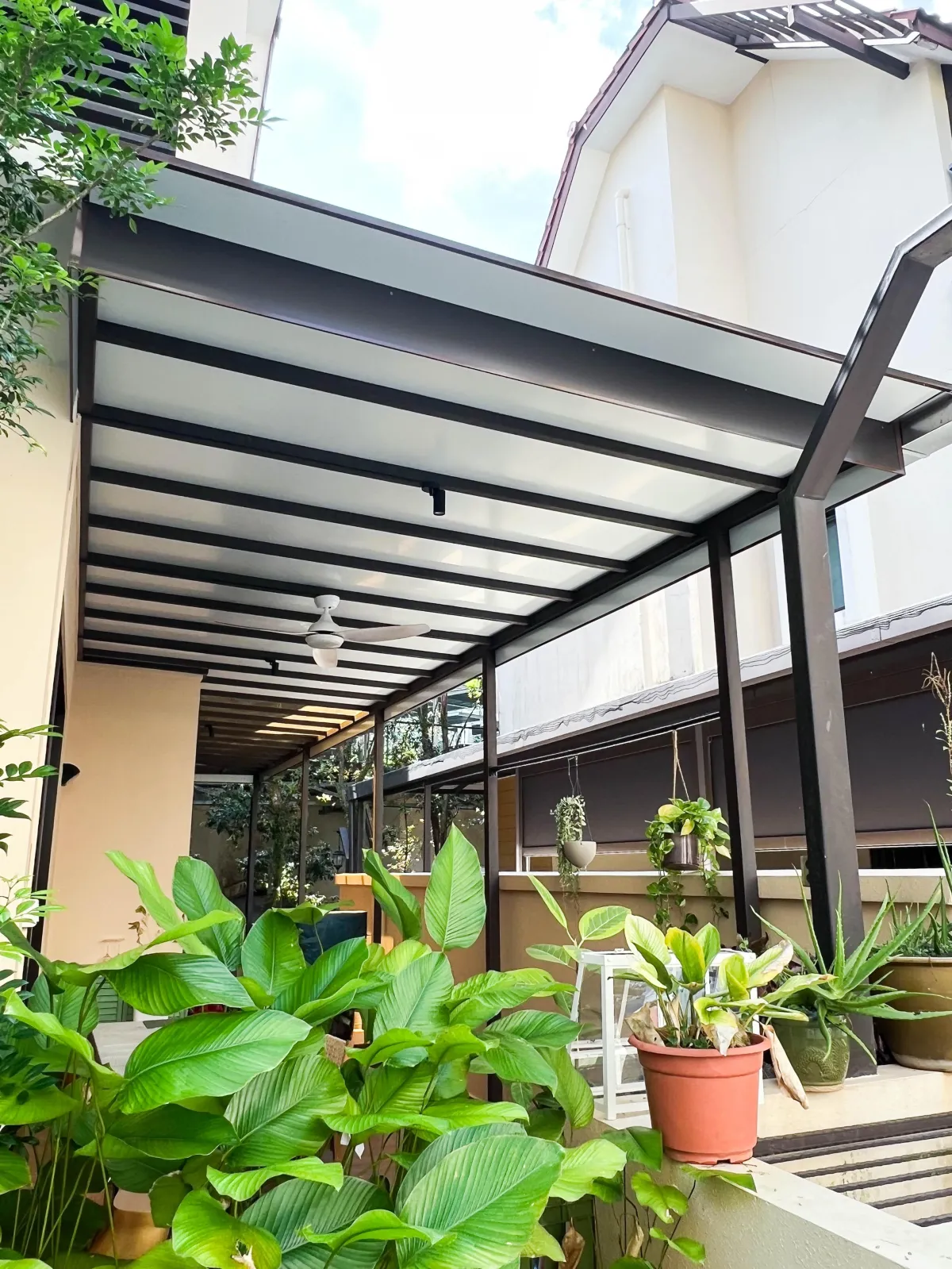
ACP offers a sleek, architectural finish. It doesn't look like a "plastic addition"; it looks like a permanent structure.
Visuals: Available in hundreds of colors, including metallic finishes and wood grains. It provides a flat, premium "ceiling-like" finish on the underside.
Atmosphere: It changes the terrace from a "covered balcony" into an "outdoor room."
3. Durability and Lifespan
How will the roof look after 5 years of Singapore’s tropical downpours and intense UV?
Maintenance Reality
ACP: Virtually maintenance-free. Because it is opaque, dirt and bird droppings on top are not visible from below. A simple annual hose-down is usually enough.
Polycarbonate: High maintenance. Dirt, dried leaves, and algae growth are visible from underneath. Over time, the sealant in the joints can fail, leading to water ingress inside the multiwall channels, which is impossible to clean.
4. Acoustic Performance: The "Rain Noise" Test
Singapore's heavy rain can be deafening on certain materials.
ACP: The composite core acts as a natural sound dampener. Rain hitting an ACP roof produces a dull, manageable "thud." It is significantly quieter than traditional metal or thin plastic roofing.
Polycarbonate: Can be quite loud. Solid polycarbonate vibrates more than composite panels, creating a "drum" effect during heavy thunderstorms. While multiwall sheets are slightly better due to the air gaps, neither compares to the acoustic dampening of ACP.
5. Regulatory and Safety Considerations
In Singapore, installing a roof over a terrace involves more than just picking a material.
URA and BCA Guidelines
The user mentioned the "risk" of it not being legal. In private properties (Condos/Landed), any structure that increases the Gross Floor Area (GFA) technically requires URA approval.
GFA Issues: If the roof cover is permanent and enclosed, it may be counted as GFA. Most developments have already exhausted their GFA, making "illegal" extensions common but risky.
MCST Approval: For condos, you must get Management Corporation (MCST) approval. They usually dictate the color and material (to ensure building uniformity).
BCA Requirements: Any structure over a certain size may require a Professional Engineer (PE) endorsement to ensure it can withstand wind loads.
Fire Safety
ACP: Always look for FR (Fire Retardant) or A2 (Non-combustible) cores. Standard PE (Polyethylene) cores are flammable and have been restricted in many high-rise applications worldwide.
Polycarbonate: It is self-extinguishing and does not support combustion, but it will melt under high heat.
6. Cost-Benefit Analysis
Initial Cost: Polycarbonate is generally 20% to 30% cheaper than ACP due to simpler installation and lower material costs.
Long-term Value: ACP is the more cost-effective choice over 15 years. Polycarbonate often requires replacement or heavy cleaning within the first 10 years, whereas ACP remains structurally and aesthetically sound for much longer.
Final Verdict: Which should you choose?
Choose Aluminium Composite (ACP Roof) if:
You plan to use the space daily as an outdoor office, gym, or dining area.
You want the coolest possible temperature underneath.
You want a low-maintenance, "set it and forget it" solution.
You prefer a modern, solid architectural look.
Choose Polycarbonate if:
The area is naturally dark and you need to bring light into the adjacent indoor rooms.
You are building a greenhouse or a space specifically for plants that need sunlight.
You have a lower upfront budget and don't mind more frequent cleaning.
You want a "glass" look without the weight or cost of tempered glass.
For a 4th-floor open terrace where heat is the primary enemy of usability, ACP is the professional recommendation. It transforms a scorching rooftop into a functional, year-round living space that feels like a premium part of the home.
Looking For A Roofing Contractor?
With over 13 years of proven expertise and more than 2,500 successfully completed projects, we are Singapore’s most trusted specialist for premium ACP and durable roof extension solutions.
Contact us today for a free on-site design and consultation to secure a 5-year limited warranty and transform your terrace with precision workmanship.
